
Have you ever been so pumped to get a card thinking it was going to sell like crazy only to find out the competition is too tight to make a profit? This happened to us ALL the time when we first started building our inventory until we dove into how to price our cards. Read on for an in-depth look into what we learned and to see the simplest way to figure this out on the fly.
Max and I are still new to this business and have made tons of mistakes…and still are. Buying cards to sell is always tough when seeking for items we think can be profitable. One example is during the 2024 National Sports Card Convention in Cleveland. I saw an iconic card from my childhood of Bo Jackson wearing football pads and holding a baseball bat at a vendor table that was more about memorabilia than cards. I saw it going for $10 on ebay and picked it up for $8. It would be a small profit margin, but worth a shot.

This is how most of our purchases went the first few months. Max was running auctions on whatnot and I was handling the ebay account. So, why was this a bad purchase?
If I was able to get $10 for it on ebay, I would have to pay a 13% commission and a $0.30 listing fee. After the 13%, I am down to $8.70 and then $8.40 after the listing fee. Even though the customer typically covers shipping, they don’t cover the cost of shipping materials. Currently, for us it is around $0.50 per package if you count the bubble mailer, cardboard, tape, top loader, and shipping label. That takes us to $7.90. We would lose a dime plus the time and effort. Have you been here before?
Our goal is to make a minimum of 20% per item sold. That means after all of the things listed above (commission, fee, shipping), I wanted to be at $9.60. In that case, the selling price for this card would have to be $12, which was above what the market value was. So, how can we be sure we are able to get a great card to sell without doing math homework in middle of a card show or card store?
Here is how we solved it for us. We did a bunch of math and found some hacks to figure it out quickly. This is not perfect, but a great way for us to make a quick decision. There are a few simple things to remember when shopping on the fly:
Assuming all cards are selling for $2 or more:
- Anything less than a dollar must be able to sell for at least $2.
- Stuff from $1 – $5 multiply by 2. This is 100% markup.
- Items from $6-$25 multiply by 1.5. This is a 50% markup.
- Items over $25 multiply by 1.4. This is a 40% markup.
Example how to do this. A card at the card store is $6.50. Look it up the recently sold listings on ebay and see that it is going for $10. Open the calculator app and multiply 7.50 X 1.5 and you will get $11.25. This would not be a good buy if you were looking for profit after the sale. However, if you could bargain the card store to $6.00 it would be a great buy because $6.00 X 1.5 is $9.00.
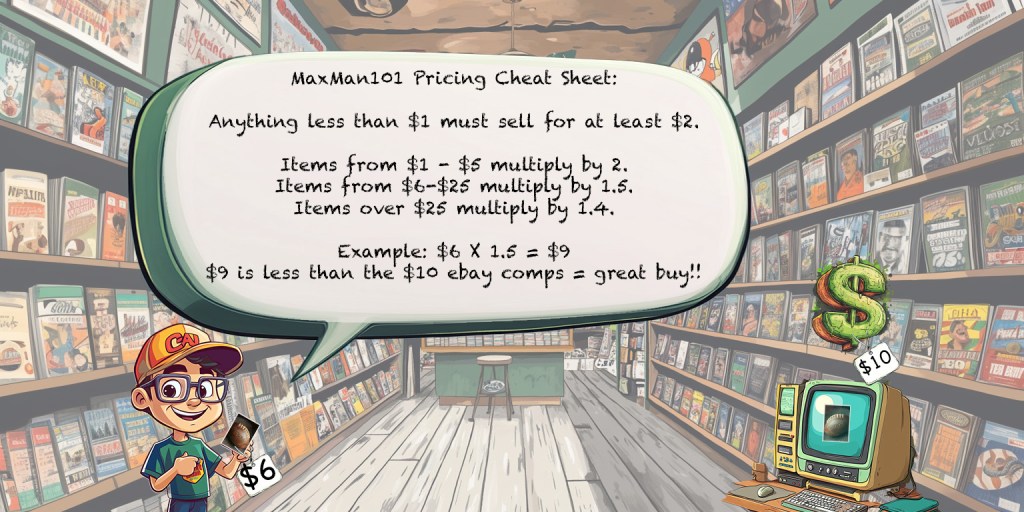
Download our FREE Cheat Sheet on this.
Only read on if you are are into the long math game or having trouble sleeping at night. Here we will show you how to get the exact number.
Think about your desired profit margin. Are you doing this for some extra cash or trying to make it a full time job? How much would you need for that? We are going to cover that in a future article, but for for now let’s just assume it is 20% profit margin.
The math is to add 20% to the price you are buying it for, then add the commission and fees. If this number is less than what you can sell it for, awesome!
Example…WARNING this is major math nerdery:
Card is $5 that you want to buy. To calculate the 20% profit into multiply by 1.2 this is mathematically saying 120% of $5 or $5+20%…same thing.
$5 X 1.2 = $6
Then add the $0.30 listing fee.
$6 + $0.30 = $6.30
Now, is the wonky part. Adding in the additional 13% is not as easy as adding 13% on top. We need to figure out the larger number that 13% is taken from. Just trust me here :). To do this we divide the number above by 1 minus the percent of the commission. For this example it is 13% and 1 – .13 is .87….so:
$6.30 / (1 – .13) =
$6.30 / (.87) = $7.24
Lastly, add in the shipping costs. For us it $0.50.
$7.24 + $0.50 = $7.74
Recap:
- Original Price X 1.2
- Add Listing fee to answer above
- Divide by 1 – commission
- Add in shipping costs
If this was helpful, let us know. Do you have a different way of doing this, let us know that too!!
 MaxMan101 Sports Cards
Leave a comment